You sit down in the barber’s chair with a head full of curls. You want something sharp, but you don’t want to lose the texture you’ve spent years learning to love. Sound familiar?
That’s exactly the problem a low taper fade curly hair cut solves. It keeps the sides and back clean, leaves your curls alone on top, and never looks like you tried too hard.
This guide to low taper fade curly hair walks through everything. You’ll learn what the cut really is, how it compares to other fades, and which of the 50 styles below suits your curl pattern. You’ll also get step-by-step styling methods, a maintenance calendar, word-for-word barber scripts and a product list.
Whether your hair is loose waves or tight coils, there’s a version here for you.
Quick answer: Low taper fade curly hair keeps the sides and nape neatly graduated while leaving length and shape on top. It starts just above the ear and hairline, so the change is subtle, professional and easy to grow out.
What Is a Low Taper Fade on Curly Hair and Which Curl Types Does It Work For?
A low taper fade curly hair cut is a haircut where the hair shortens gradually around the ears and neckline. The length on top stays as you choose it. On curly hair, that contrast is the whole appeal.
It works on nearly every curl type. Waves, loose curls, springy ringlets, tight coils and kinky textures all take a taper well. What changes from person to person is the top length and how you style it.
The Low Taper Fade: A Precise Barbering Definition
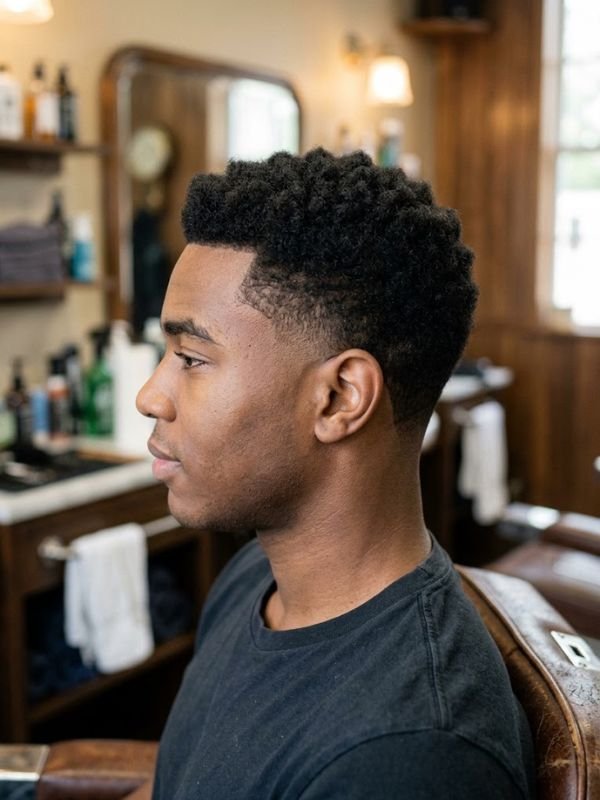
Two words matter here: taper and fade.
- Taper: the hair gets gradually shorter toward the hairline. It usually stops at a visible length rather than skin.
- Fade: the hair blends down to very short stubble or skin.
- Low: the change starts just above the ear and follows the natural hairline around the back.
In practice, a low taper leaves most of the side untouched. Only the sideburn area, the ear curve and the nape get cleaned up. That’s why it looks so soft compared with a mid or high fade.
Barbers often finish the edges with a trimmer or a razor to sharpen the outline. That crisp line against soft curls is what people notice first.
Why Curly Hair and the Low Taper Fade Work So Well Together
Curly hair grows out and up, not down. Left alone, the sides can puff into a triangle shape. A taper controls that width without cutting the curls on top.
Here’s what low taper fade curly hair does for texture:
- Reduces bulk around the ears, where curls tend to expand.
- Frames the curls so they look intentional, not messy.
- Keeps length where curls need weight to define themselves.
- Grows out gracefully, because there’s no harsh line to fight.
Think of it like a picture frame. The frame doesn’t change the picture. It just makes the picture look finished.
Is a Low Taper Good for Curly Hair?
Yes. Low taper fade curly hair is one of the safest and most flattering choices. The low starting point protects your curl mass and avoids exposing too much scalp.
It also suits offices, schools and formal events. If you’ve never had a fade before, this is the easiest way to try one.
The one caution is with very fine, thin curls. A taper can make the top look sparse if the sides are cut too tight. Ask your barber to leave a bit more length on the side and blend gently.
Low Taper Fade vs. Other Fades: Which One Is Right for Your Curls?
Not every fade suits every head. Height, width and blend all change the final look. Use this table to compare.
| Fade type | Starts at | Contrast with curls | Best for | Upkeep |
| Low taper | Just above ear and nape | Subtle | Offices, first-timers, growing out | Every 3–4 weeks |
| Low fade | Just above ear, goes to skin | Medium | Clean but soft look | Every 2–3 weeks |
| Mid taper | Around temple level | Medium-high | Balanced, modern look | Every 2–3 weeks |
| Mid fade | Temple level, to skin | High | Bold curls on top | Every 2 weeks |
| High fade | Above temple | Very high | Streetwear, statement looks | Every 1–2 weeks |
| Drop fade | Curves behind ear | High | Curved, dramatic shapes | Every 2 weeks |
| Burst fade | Circles the ear | High | Mohawks, mullets, twists | Every 2 weeks |
Taper vs. Fade: The Simple Difference
A taper leaves visible hair at the bottom. A fade goes down to skin. Many barbers combine them, which is why you’ll hear “low taper fade” as one phrase.
Which One Should You Pick?
- Pick a low taper if you want subtle and low-maintenance.
- Pick a low fade if you want cleaner edges against your skin.
- Pick a mid option if your curls are big and you want more contrast.
- Pick a high cut only if you love a bold, graphic silhouette.
If you’re on the fence, start low. You can always go higher next visit, but you can’t put hair back.
ALSO READ “Low Taper Fade Long Hair: 35 Best Styles for Every“
50 Best Low Taper Fade Curly Hair Styles for Men
Below are 50 low taper fade curly hair ideas, grouped by mood. Each one lists the ideal curl type, the top length and a styling hint. Screenshot the ones you like and show your barber.
Classic & Essential Styles
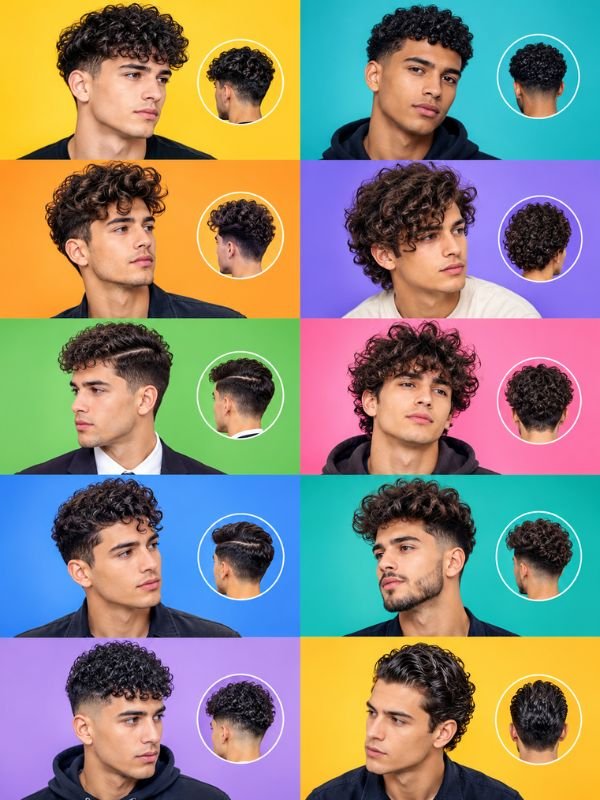
1. The Everyday Curly Taper — Curl types 2B–3B. Two to three inches on top, natural curls, clean sides. Apply a curl cream and let it air-dry. It’s the default for a reason.
2. The Short Curly Crop — Types 3A–4A. One inch of curl on top with a soft low taper. Almost no styling needed. Great for busy mornings.
3. The Textured Quiff — Types 2A–3A. Push the front curls up and back. A little matte paste adds lift without shine.
4. The Curly Side Sweep — Types 2B–3A. Curls fall gently to one side. Use a light gel to keep the direction steady.
5. The Curly Ivy League — Types 2A–2C. Slightly longer on top, with a side part and a tidy taper. Looks smart in a shirt and tie.
6. The Messy Curls Taper — Types 3A–3C. Roughly four inches of tousled curls. Scrunch in a sea salt spray and leave it alone.
7. The Curly Comb-Over — Types 2B–3B. A sharp part, curls swept across, low taper underneath. Formal but still youthful.
8. The Soft Curly Pompadour — Types 3A–3B. Height at the front, softness at the sides. Blow-dry upward with a diffuser for lift.
9. The Curly Caesar — Types 3B–4A. Short, forward-lying curls with a defined low taper. Easy to maintain and hard to get wrong.
10. The Curly Slick Back — Types 2A–3A. Comb curls back with a wet-look gel. The taper keeps the sides flat and tidy.
Short & Low-Maintenance Styles
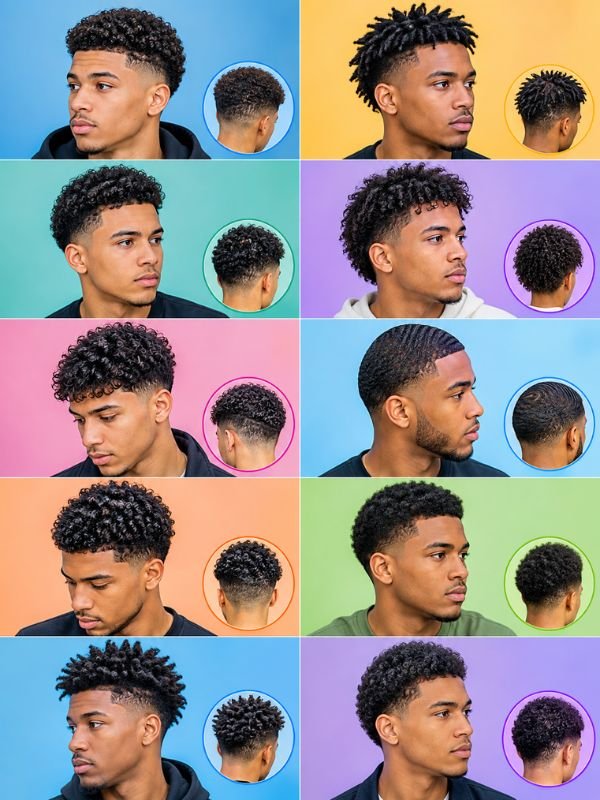
11. The Buzzed Curl Top — Types 3C–4C. Half an inch of curl with a razor-fine taper. Wash and go.
12. The Micro Twist Top — Types 4A–4C. Short coils twisted into small nubs. A low taper frames them cleanly.
13. The Curly Crew Cut — Types 3A–4B. Slightly longer at the front, short elsewhere. Neat, athletic and easy.
14. The Lazy Man’s Taper — Types 2B–3C. Two inches, no product beyond a leave-in. Works when you hate routines.
15. The Curly French Crop — Types 2A–3B. Short fringe, textured top, soft taper. Use a light clay and finger-comb it forward.
16. The Wave Cap Taper — Types 3C–4C. Brush-and-wave pattern on top with a low taper. Needs a durag at night.
17. The Low Curl Cut — Types 3B–4A. About an inch of defined curl and a slim taper. It’s tidy and subtle.
18. The Curly Butch Cut — Types 3A–4A. Even length across the top with a low taper. Bold, simple and nearly bulletproof.
19. The Coil Fade Top — Types 4B–4C. Coils twisted, or coil-sponged for definition. Shows off tight texture.
20. The Shadow Taper — Types 3B–4B. A very gentle blend that barely reads as a fade. Suits conservative workplaces.
Medium-Length & Voluminous Styles
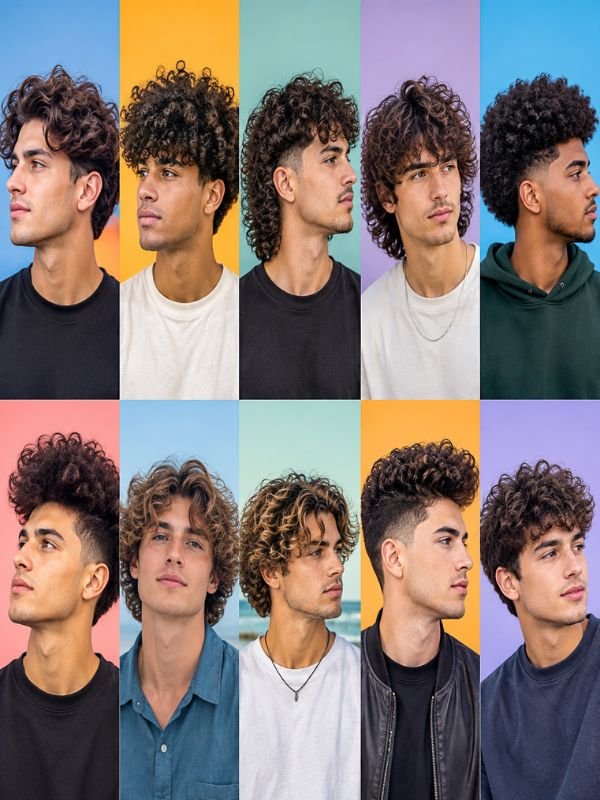
21. The Curly Flow Taper — Types 2B–3B. Four to six inches, swept away from the face. Tapered sides keep it wearable.
22. The Big Curl Volume Cut — Types 3B–3C. Round curls with plenty of height. Diffuse to lock in bounce.
23. The Curly Mullet Taper — Types 2C–3B. Short sides, longer back, and a low taper to keep it clean. It’s playful, not messy.
24. The Curly Shag Taper — Types 2B–3A. Layered top with choppy ends. Add sea salt spray for shape.
25. The Curly Afro Taper — Types 4A–4C. A rounded, full top with a low taper. Shape it with an afro pick.
26. The Curly Blowout Taper — Types 3B–4B. Blow-dried up and out for maximum height. Best for people who want drama.
27. The Curly Bedhead — Types 2A–3A. Loose, slept-in waves and a subtle taper. Effortless in the best way.
28. The Curly Surfer Cut — Types 2A–2C. Beachy, mid-length waves. Use texture spray for grit.
29. The Curly Pompadour Blowout — Types 3A–4A. Big height, smooth sides. A retro style with a modern edge.
30. The Tousled Top Taper — Types 2C–3C. A relaxed top with soft layers. Finish with a hint of cream.
Bold & Statement Styles
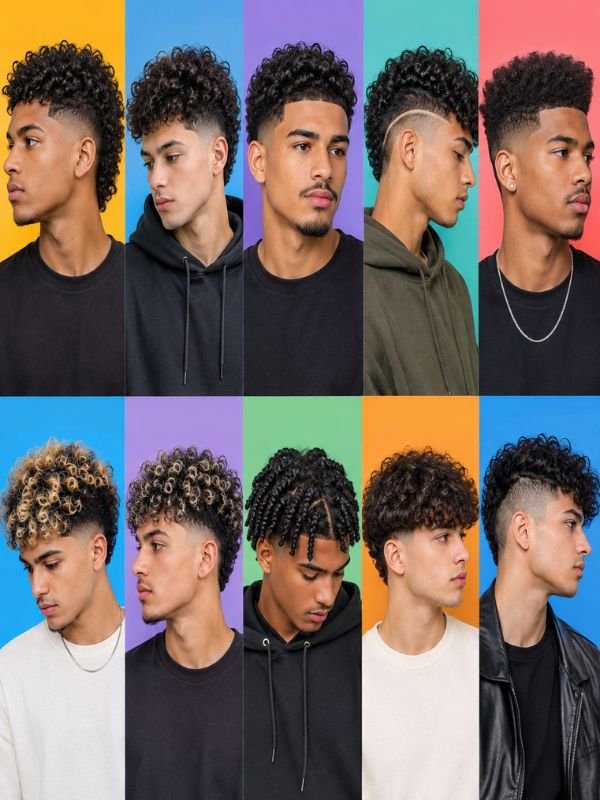
31. The Curly Mohawk Taper — Types 3A–4B. Curls stand in a strip down the center. Low tapered sides make it wearable.
32. The Curly Faux Hawk — Types 2B–3C. Sides pushed inward, center pushed up. A gentler version of the mohawk.
33. The Line-Up Curl Cut — Types 3B–4C. A crisp hairline paired with soft curls. Sharp lines are the star.
34. The Design Taper — Types 3C–4C. A thin razor line or shape cut into the side. Ask for it only if your barber is skilled.
35. The Curly High-Top Taper — Types 4A–4C. A flat, boxy top with a low taper. A nod to the ’90s.
36. The Dyed Curl Top — Types 2A–4B. Bleach and tone the curls for contrast. Keep the taper natural so the color pops.
37. The Frosted Tips Taper — Types 3A–3C. Lightly bleached curl ends. Playful and easy to grow out.
38. The Twist-Out Taper — Types 3C–4C. Two-strand twists released for a stretched pattern. Defined and photogenic.
39. The Curly Bowl Taper — Types 2A–3B. A rounded, forward-falling shape. Retro, but done modern.
40. The Undercut Curl Taper — Types 3A–4A. Disconnected top and tight sides. More contrast, more attitude.
Styles for Longer Curls & Special Looks
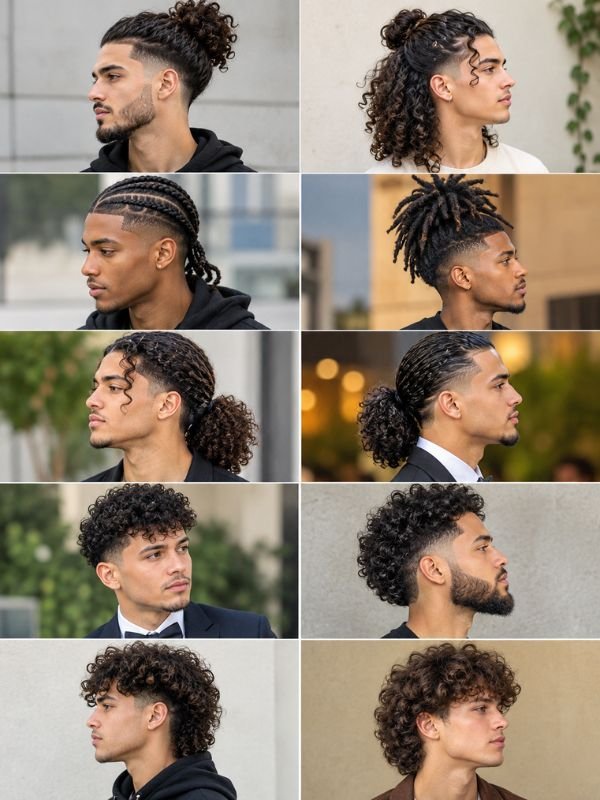
41. The Man Bun Taper — Types 2A–3C. Long curls tied up while the sides stay clean. Practical and stylish.
42. The Half-Up Curl Taper — Types 2B–3C. Top section tied back, the rest down. Works with medium length.
43. The Curly Braid Taper — Types 3B–4C. Cornrows or braids on top with a low taper. A protective and polished pair.
44. The Dreadlock Taper — Types 3C–4C. Locs on top, clean sides. Keeps the roots neat between retwists.
45. The Curly Ponytail Taper — Types 2A–3B. A low ponytail from long top curls. Good when you’re growing your hair.
46. The Curly Slick Ponytail — Types 3A–4A. Gelled back and tied, with the taper doing the framing. Sharp for events.
47. The Wedding-Day Curl Taper — Types 2A–4C. Fresh taper, a soft-hold gel and defined curls. Book it two days before.
48. The Curly Beard-Blend Taper — Types 2A–4C. The taper blends into a beard so there’s no visible break. Ask for a seamless join.
49. The Curly Grow-Out Taper — Types 2A–4C. A transition cut for people growing their length. Keep the sides tidy while the top gets longer.
50. The Curly Retro Taper — Types 2A–3C. A 1970s-inspired shape with a modern taper. Adds character without effort.
How to Pick From the 50 Styles
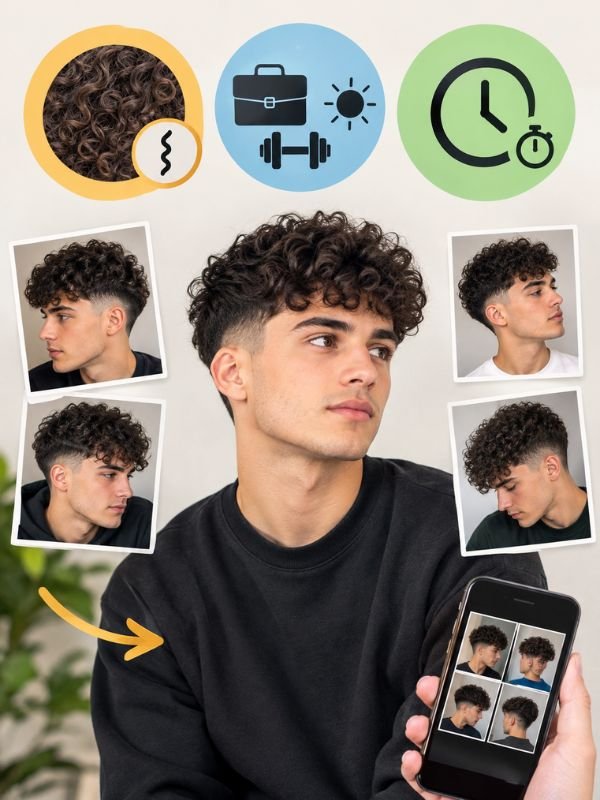
Don’t try to choose all at once. Use three filters:
- Curl type. Match the style to your natural pattern.
- Lifestyle. Work dress code, sport and morning routine all matter.
- Time. If you have five minutes, go short. If you like styling, go longer.
Pick two or three low taper fade curly hair favorites and take photos to your barber. Photos beat descriptions every time.
How to Choose the Best Low Taper Fade for Your Curl Type
Curl type is the biggest factor in how a cut will behave. Hair pattern is usually described on a 2 to 4 scale, with letters A to C marking how tight the curl is.
| Curl type | Pattern | Recommended top length | Notes for the taper |
| 2A–2C | Wavy | 3–5 inches | Keep the taper soft so waves don’t look flat |
| 3A–3B | Loose to springy curls | 2–4 inches | Leave a little length at the sides for balance |
| 3C | Tight corkscrews | 1.5–3 inches | Taper can be slightly tighter for a crisp outline |
| 4A | Coily, S-shaped | 1–3 inches | Shape-up on the front hairline looks great |
| 4B | Z-shaped, less defined | 1–2 inches | Ask for a rounded top to avoid boxiness |
| 4C | Very tight coils | 0.5–2 inches | Choose a smooth blend to avoid harsh lines |
Wavy Hair (Type 2)
Waves need weight to keep their pattern. Cut them too short and they straighten out. Aim for at least three inches on top and a soft taper.
Curly Hair (Type 3)
Type 3 curls bounce back when they’re hydrated. They also shrink when dry, so ask your barber to cut them dry, not wet, so you can see the real length.
Coily Hair (Type 4)
Coils have the most shrinkage, sometimes 70 percent. A cut that looks two inches long may really be six. Tell your barber your goal length, then let them account for shrinkage.
A Note on Mixed Patterns
Many people have two textures on one head. The nape can be tighter than the crown, for instance. A good barber will notice that and adjust the blend.
Low Taper Fade for Every Face Shape: Your Complete Matching Guide
Face shape decides where volume should sit. The goal is balance. You want your cut to soften strong angles and add length or width where it’s missing.
| Face shape | Key features | Best curl top | Taper tip |
| Oval | Balanced, slightly longer than wide | Almost anything | Keep it natural; you can wear all 50 styles |
| Round | Full cheeks, soft jaw | Height on top | Slightly tighter taper adds length |
| Square | Strong jaw, wide forehead | Soft, textured curls | Low taper softens angles |
| Rectangle / Oblong | Long face, high forehead | Fringe or side volume | Avoid too much height |
| Heart | Wide forehead, narrow chin | Medium length, side sweep | Leave some fullness near the ears |
| Diamond | Wide cheekbones, narrow forehead | Forward-falling fringe | Keep the sides slightly fuller |
| Triangle | Narrow forehead, wide jaw | Volume on top | A clean taper lightens the jaw |
Oval Faces
You’re the lucky one. Nearly every top length and curl arrangement works. Pick based on personality, not geometry.
Round Faces
Round faces need vertical lines. Build height on top and keep the sides clean. A textured quiff or a curly pompadour lengthens the face nicely.
Square Faces
Your jaw is already strong. Let the curls soften it. A messy, medium-length top with a gentle taper creates a great contrast.
Rectangle Faces
Avoid stacking height, since it makes the face look longer. Go for a fringe, side volume or a curly sweep instead. That adds width where you need it.
Heart-Shaped Faces
A wide forehead needs balance at the chin. A side-swept fringe softens the top, while a low taper keeps the temples from looking too narrow.
Diamond and Triangle Faces
Diamond faces do well with forward-falling curls. Triangle faces do best with volume on top to balance a broad jaw. In both cases, the low taper keeps things neat.
How to Style a Low Taper Fade with Curly Hair at Home (Step-by-Step)
A good low taper fade curly hair cut is only half of the result. The rest is what you do in the bathroom. Here are three methods that cover most curl types.
For a Natural, Effortless Look (Air-Dry Method)
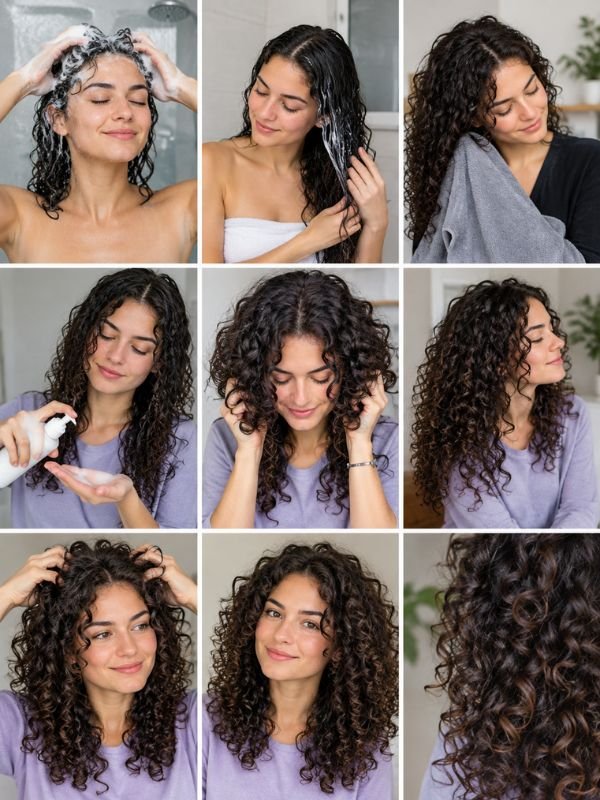
Best for types 2A–3B. It takes about five minutes of hands-on time.
- Wash gently. Use a sulfate-free shampoo two or three times a week.
- Condition every time. Rinse out most of it, but leave a little in.
- Squeeze out water. Use a microfiber towel or old T-shirt. Don’t rub.
- Apply a leave-in or curl cream to soaking-wet hair.
- Scrunch upward to encourage curl formation.
- Leave it alone until it’s dry. Touching it causes frizz.
- Fluff at the roots with your fingers once dry.
The trick here is patience. Every time you touch damp curls, you break up the clumps.
For a Polished, Defined Look (Diffuser Method)
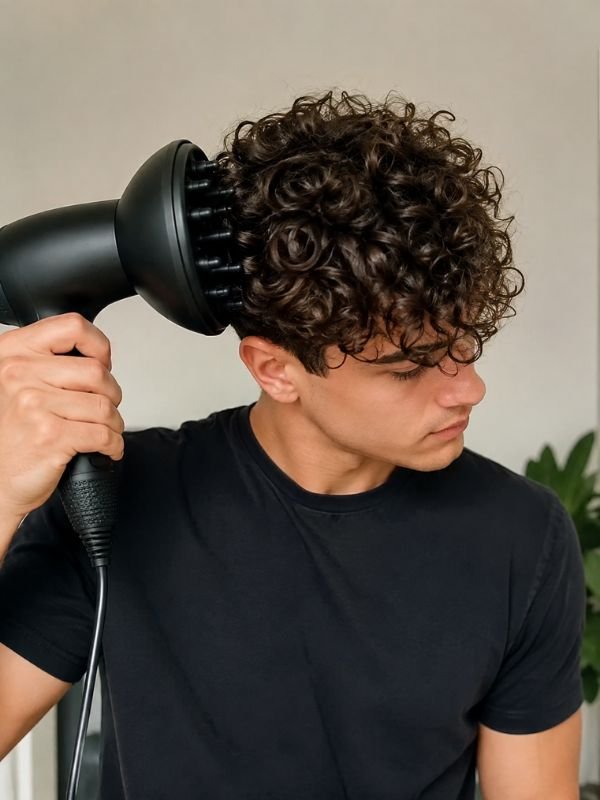
Best for types 3A–3C, or anyone who wants extra definition.
- Follow the same first four steps as above.
- Add a gel or mousse and scrunch it in.
- Attach a diffuser to your dryer and set it to low heat and low speed.
- Cup sections of curls in the diffuser and hold for 30 seconds.
- Move around the head, working from the sides to the crown.
- Let the hair cool. Break the cast by gently scrunching out the crunchy feel.
Heat can dry curls out, so use a heat protectant every time. Keep the dryer a few inches from your head.
For Maximum Volume (Blowout Method: Type 3C–4C)
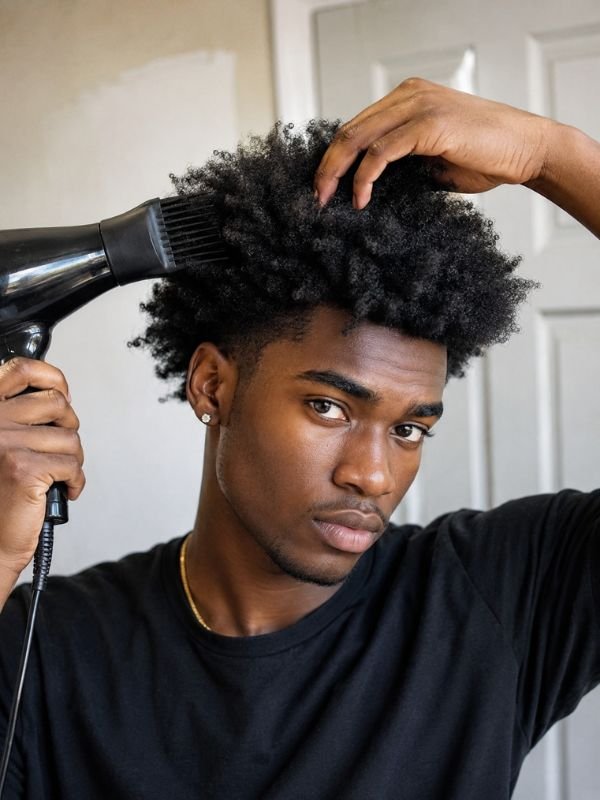
This is a bigger project, around 15 to 20 minutes.
- Start with damp, detangled hair.
- Apply a heat protectant and a light cream.
- Use a comb attachment on your dryer, or a pick and dryer combo.
- Work in small sections, pulling the hair up and out.
- Shape the top with an afro pick once dry.
- Finish with a light oil for shine.
Do this only once a week or so. Repeated high heat damages coils, which are already the most fragile curl type.
Fast Fixes for Bad Hair Days
- Frizzy? Mist with water and add a pea-sized amount of cream.
- Flat? Flip your head upside down and fluff the roots.
- Greasy? Skip the product and rinse with cool water.
- Sleeping on it? Use a satin pillowcase or bonnet.
How to Maintain a Low Taper Fade with Curly Hair: The Complete Care Routine
With low taper fade curly hair, the line fades. In about two weeks the crisp line starts to soften. Curls grow faster than they look, and a good maintenance plan keeps the cut sharp.
Barber Maintenance Schedule
| Timing | What to do |
| Every 2 weeks | Quick clean-up of neckline and edges (optional) |
| Every 3–4 weeks | Full low taper refresh |
| Every 6–8 weeks | Reshape the top and trim split ends |
| Once a year | Consider a fresh style or color change |
Barbers often offer a cheaper “line-up only” visit. It’s a smart option between full cuts.
At-Home Curl Care Schedule
| Frequency | Routine |
| Daily | Refresh curls with water and a bit of leave-in |
| 2–3 times a week | Wash with a gentle shampoo |
| Weekly | Deep condition for 10–15 minutes |
| Every 2 weeks | Clarify to remove product build-up |
| Nightly | Protect hair with satin |
Common Mistakes to Avoid
Even good cuts get ruined by bad habits. Watch for these.
- Brushing dry curls. It breaks the pattern and creates frizz.
- Using too much product. Curls get crunchy, heavy and dull.
- Skipping conditioner. Curly hair is naturally drier than straight hair.
- Washing every day. It strips the oils that keep curls soft.
- Waiting too long between cuts. The taper grows out and looks scruffy.
- Ignoring the scalp. Dry or flaky skin under short sides shows more.
- Hot showers. They dry hair out. Finish with cool water.
Scalp Care Matters More Than You Think
With shorter sides, your scalp is more exposed. Massage it while you shampoo to boost blood flow. If you notice flakes, try an anti-dandruff shampoo once a week. Sunscreen on exposed areas is smart in summer, too.
Seasonal Tips
- Summer: Use lightweight gels and a UV-protective spray.
- Winter: Layer richer creams and avoid hats without a satin lining.
- Humid weather: Choose a strong-hold gel to fight frizz.
- Dry weather: Use oils or butters to seal in moisture.
What to Tell Your Barber: Low Taper Fade Curly Hair Scripts
Most bad haircuts, low taper fade curly hair included, come from bad communication. “Just a little off the sides” means something different to every barber. Numbers, photos and clear language fix that.
Before you go, do three things. Wash your hair the night before, but skip heavy product. Bring two or three reference photos, ideally of hair like yours. And arrive with curls that are dry and natural, so your barber can see how they behave.
Universal Barber Script (All Curl Types)
Read this out or paste it into your notes app:
“I’d like a low taper fade on the sides and back. Start the taper just above my ear and follow my natural hairline around the nape. Leave about [3 inches] on top, and please cut it dry so we can see the curl pattern. I’d like a soft blend, not a hard line. Here’s a photo of what I mean.”
Why it works: you’ve given a fade height, a top length, a cutting method and a visual. That’s nearly everything a barber needs.
Blowout Low Taper Fade Barber Script
For volume and height on types 3B–4B:
“I want a low taper fade with a blowout on top. Please leave enough length to blow-dry upward, around [4 inches]. Keep the taper clean and tapered, not down to skin, and give me a natural, rounded shape on top. I’ll be styling with a diffuser and a pick.”
If your barber doesn’t blow-dry, ask for the cut to be done on dry hair and style it yourself afterward.
Afro / Type 4 Barber Script
For coily, tightly patterned hair:
“I have type 4 hair, so I know it shrinks. I want a low taper fade with a defined shape-up in front. Please keep the top around [2 inches] when stretched, and shape it round so it doesn’t go boxy. I’d like a smooth blend around the ears and neckline. I don’t want any harsh lines.”
Mentioning shrinkage tells your barber you understand your hair. It also prevents the “why is it so short?” surprise.
Key Questions to Ask Your Barber
Good barbers welcome questions. Try these.
- “Have you cut curly or coily hair before?” Experience matters a lot.
- “What guard number are you using at the bottom?” A #1 is very short, a #3 is longer.
- “How long will this last?” You’ll get a realistic timeline.
- “What product would you recommend for my texture?” Barbers often know local favorites.
- “Can you show me the back before I leave?” Check the neckline in a hand mirror.
Understanding Clipper Numbers
| Guard | Length | Typical use in a low taper |
| Blade / Bald | 0 mm (skin) | Very bottom of a fade |
| #0.5 | 1.5 mm | Just above skin |
| #1 | 3 mm | Bottom of most tapers |
| #2 | 6 mm | Mid section |
| #3 | 10 mm | Upper taper zone |
| #4 | 13 mm | Blend into the top |
You don’t need to memorize these. Just know that lower numbers mean shorter hair.
How to Find a Good Barber for Curls
Look at their social media. Do they show curly, wavy and coily clients? Check whether the photos show clean blends and healthy curls. Read reviews that mention texture. If a barber only posts straight-hair fades, keep looking.
Also watch how they behave. A good curly-hair barber asks about your routine, checks your parting and looks at how your curls fall before cutting.
Products Every Man with a Low Taper Fade Curly Hair Needs
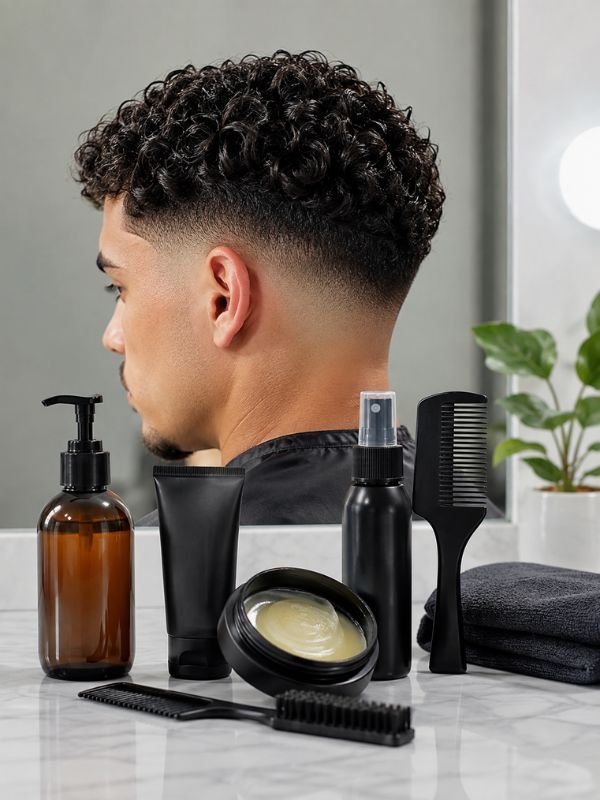
For low taper fade curly hair, you don’t need twenty products. Six well-chosen ones will do the job.
| Product | What it does | Best for | How to use |
| Sulfate-free shampoo | Cleans without stripping oils | All curl types | 2–3 times weekly |
| Rich conditioner | Adds slip and moisture | Types 3–4 | Every wash |
| Leave-in conditioner | Locks in hydration | All curls | On damp hair |
| Curl cream | Defines and softens | Types 2B–4A | Scrunch into wet hair |
| Gel or mousse | Holds shape | Types 2–3, humid weather | Layer over cream |
| Texture spray / sea salt | Adds grit and volume | Types 2A–3A | On dry hair |
| Light oil | Adds shine, seals moisture | Types 3C–4C | A drop on dry ends |
Tools Worth Owning
- Wide-tooth comb for detangling in the shower.
- Microfiber towel to reduce frizz.
- Diffuser to dry with definition.
- Afro pick to add volume without disturbing curls.
- Satin bonnet or pillowcase to protect curls overnight.
- Soft-bristle brush to smooth the tapered sides (not the curls).
Ingredients to Look For and Avoid
Look for glycerin, aloe vera, shea butter, panthenol and natural oils like jojoba or argan. They bring moisture and softness.
Try to avoid sulfates, heavy silicones and drying alcohols. They can leave curls dull, stiff or brittle over time. Not every silicone is bad, but they can build up on tightly coiled hair.
How Much Product Is Enough?
A good rule is start small. For short curls, use a coin-sized amount of cream and a similar amount of gel. Add more only if the hair still feels dry. It’s easier to add than take away.
Pros and Cons of the Low Taper Fade on Curly Hair
Every cut has trade-offs. Here’s an honest look.
Pros
- Looks clean without looking severe.
- Suits work, school, weddings and weekends.
- Easy to grow out.
- Works with almost every curl pattern.
- Frames curls and shows off their shape.
- Gives you room to change the top over time.
Cons
- Needs regular touch-ups to stay sharp.
- Fine or thin hair can look sparse if cut too tight.
- Some barbers aren’t skilled with tight coils.
- The low starting point is less dramatic than a high fade.
If the pros matter more to you, and for most people they do, low taper fade curly hair is a smart choice.
How Much Does a Low Taper Fade Curly Hair Cut Cost?
Prices vary by city, shop and barber experience. As a rough guide, a standard men’s fade usually costs somewhere between 25 and 60 US dollars, and more in upscale shops. A line-up alone is often cheaper. Add ten to fifteen dollars for a beard blend or design.
Tipping is customary in many places. Fifteen to twenty percent is common. Check local norms if you’re traveling.
Budget tip: book a full cut every four to five weeks, and a quick clean-up in between. That keeps things sharp without draining your wallet.
Understanding Your Curls: The Science Behind the Cut
A little hair knowledge goes a long way with low taper fade curly hair. It helps you talk to your barber, choose products and stop wasting money on things that don’t work.
Why Curly Hair Behaves the Way It Does
Curly hair grows from an oval or flattened follicle, which makes the strand bend as it emerges. The tighter the bend, the tighter the curl. Because of those bends, natural scalp oils have a hard time sliding down the strand. That’s why curls feel drier than straight hair, even on an oily scalp.
Those same bends also create weak points. Each curve is a place where the hair can snap if you pull, brush or heat it too hard. It explains why gentle handling matters so much for coils.
Shrinkage: The Surprise Every Curly Guy Knows
Shrinkage is how much shorter your hair looks when dry compared with its stretched length. Wavy hair might shrink 10 to 20 percent. Tight coils can shrink by half or more.
Here’s why it matters at the barbershop. If you ask for “two inches” and your barber measures wet or stretched hair, it may dry to under one inch. Always cut dry, or agree on a length that includes shrinkage.
Porosity: Your Hair’s Thirst Level
Porosity describes how well hair absorbs and holds moisture.
- Low porosity: Water beads on the surface. Use lightweight products and a little warmth to help them absorb.
- Medium porosity: Balanced. Most products work well.
- High porosity: Absorbs fast but dries fast. Use richer creams, butters and sealing oils.
A simple test: drop a clean strand in water. If it floats for a long time, it’s likely low porosity. If it sinks fast, it’s likely high.
Density and Thickness
Density is how many strands you have. Thickness is how wide each strand is. You can have thin strands with high density, or thick strands with low density.
Thick, dense curls handle a low taper easily and can carry longer tops. Fine, low-density curls look best with a softer blend and a bit of length at the sides so the top doesn’t feel too light.
Best Low Taper Fade Styles for Different Occasions
Your low taper fade curly hair cut should fit your life. Here are quick recommendations.
| Occasion | Recommended style | Styling tip |
| Job interview | Everyday Curly Taper, Curly Ivy League | Use a light gel for a tidy finish |
| Wedding | Soft Pompadour, Curly Side Sweep | Get a fresh cut two days before |
| Gym | Short Curly Crop, Buzzed Curl Top | Use minimal product |
| Beach / summer | Curly Surfer Cut, Bedhead | Add sea salt spray |
| Date night | Textured Quiff, Twist-Out Taper | Refresh with water and cream |
| Festival / party | Dyed Curl Top, Mohawk Taper | Use a strong gel |
| Everyday casual | Messy Curls Taper | Air-dry with cream |
Office and Formal Settings
A low taper is one of the most workplace-friendly fades around. Keep the top under four inches, add a side part and use a matte product. That look reads as smart without being stiff.
Sports and Active Lifestyles
If you sweat a lot, go short and low-maintenance. A shorter top dries faster and needs fewer products. Rinse your scalp after workouts to avoid build-up and itchiness.
Weddings and Photos
Book your appointment two to three days ahead. A fresh cut looks a bit stark on day one, and a couple of days lets the edges settle. Bring a reference photo and use a flexible hold gel that won’t flake on camera.
Pairing Your Taper with a Beard
Many men with curls also have beards, and the two should look like they belong together.
The Seamless Blend
Ask your barber to blend the sideburn into the beard with a long, gradual taper. There shouldn’t be a visible line where hair stops and skin starts. A smooth transition keeps everything looking planned.
Beard Length Guide
- Stubble: Pairs with almost any top length. Modern and low-effort.
- Short boxed beard: Balances a taller curly top.
- Full beard: Works with short curly tops so the head doesn’t look heavy.
- Patchy beard: Keep it short and let the taper do the shaping.
Beard Care Basics
Wash with a gentle beard wash, condition it and use a few drops of oil. Comb or brush it daily. Coarse curly beards can be prickly and dry, so moisture is the same priority as it is on your head.
Low Taper Fade for Thinning or Receding Hair
Curly hair can hide thinning better than straight hair, because curls add volume and cover more scalp. A low taper is a good option here since it doesn’t expose too much skin.
Some tips:
- Keep the top slightly longer so it can cover the front.
- Avoid a very high fade, which highlights the difference between top and sides.
- Choose textured styles like a quiff or messy curls that create the look of fullness.
- Use a lightweight product. Heavy gels clump curls and reveal the scalp.
- Talk to a doctor if you notice sudden or patchy hair loss.
How to Grow Out a Low Taper Fade Gracefully
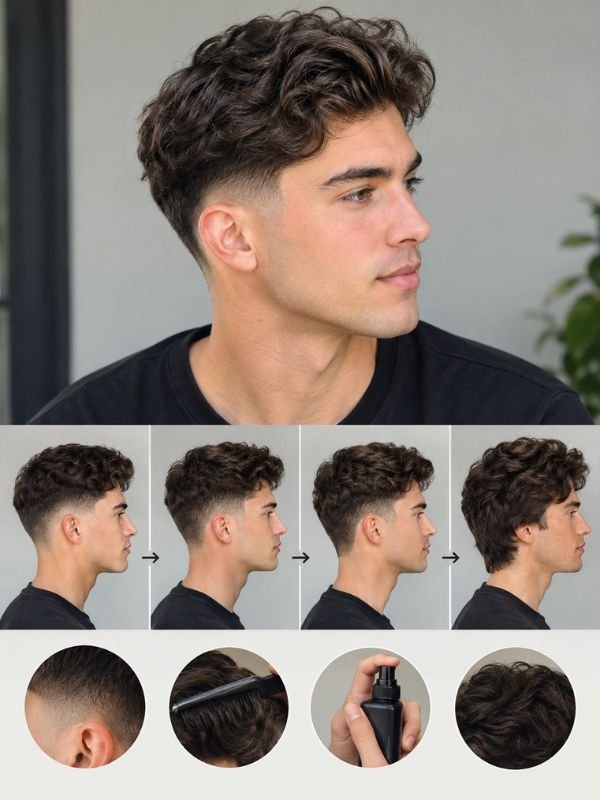
Sometimes you want length. The low taper is one of the friendliest cuts for that goal.
The Grow-Out Timeline
| Month | What you’ll see | What to ask your barber |
| 1 | Sharp edges soften | Just a clean-up around ears and neck |
| 2 | Sides begin to puff | Slightly higher taper or a blend with scissors |
| 3 | Top curls reach mid-length | Trim split ends, keep the nape tidy |
| 4–6 | Length becomes styleable | Shape the outline, maintain the neckline |
| 6+ | Full curl pattern forms | Consider a longer style like the Flow Taper |
Keeping It Neat During the Awkward Stage
Almost everyone hates the in-between stage. Beat it with these tricks.
- Keep the nape and sideburns clean.
- Use a light gel to control the sides.
- Wear it with a headband or cap on bad days.
- Use a pick to shape the top, not flatten it.
- Be patient. Curls grow slower than they look because of shrinkage.
Nutrition and Lifestyle Habits for Healthier Curls
What you eat affects your hair. It won’t fix everything, but it helps.
- Protein (eggs, fish, beans, chicken) supports the keratin your hair is made of.
- Iron and zinc help with growth and shedding.
- Omega-3 fats (salmon, walnuts, flax) support scalp health.
- Vitamin C and E support circulation and protect follicles.
- Water keeps your body, and your hair, hydrated.
Sleep matters too. So does managing stress, since high stress can increase shedding. If you’re worried about deficiencies, get a blood test rather than guessing.
Common Myths About Curly Hair and Fades
Myth: Curly hair can’t be faded. Reality: Curls take fades beautifully. The key is a barber who understands texture.
Myth: Cutting hair makes it grow faster. Reality: Growth happens at the root. Trimming removes damage so hair looks healthier and holds length.
Myth: You should never wash curly hair. Reality: You should wash it, just less often, with gentle products.
Myth: Curls need heavy products. Reality: More product usually means more build-up. Match the weight to your porosity.
Myth: Taper fades are only for short hair. Reality: Tapers pair well with long curls, braids, locs and buns.
Myth: All barbers can cut curls. Reality: Cutting curls is a skill. Look for proof in their portfolio.
Common Barber Mistakes with Curly Hair (and How to Avoid Them)
Even good barbers can slip when working with texture. Watch for these red flags.
- Cutting wet hair without accounting for shrinkage. Ask for a dry cut.
- Using only clippers on top. Curls usually need scissors for shape.
- Blending too high. It can expose scalp and change your silhouette.
- Over-thinning. Too much thinning creates frizz.
- Uneven neckline. Check the back with a hand mirror.
- Ignoring your curl pattern. Curls should be shaped along the way they naturally fall.
If something feels off, speak up politely before they finish. Small corrections are easy while you’re still in the chair.
What Happens in the Chair: A Step-by-Step Look at the Cut
Knowing what your barber does during low taper fade curly hair work takes away the anxiety. Here’s how a typical low taper on curls unfolds, from the moment you sit down.
Step 1: The Consultation
A good visit starts with talking, not clipping. Your barber checks your curl pattern, cowlicks, hairline and density. They may run their fingers through your hair to feel the texture. This is your moment to share photos and explain how you like to style it.
Step 2: Sectioning the Hair
The barber divides the head into zones. The top is clipped out of the way, and the sides and back are prepared for tapering. On curly hair, sectioning is especially important, because curls can hide uneven areas.
Step 3: Setting the Guide Line
Next comes the starting point of the taper. A low taper typically begins about an inch or two above the ear and follows the natural curve down to the nape. Your barber sets this line first so the rest of the blend has a clear guide.
Step 4: Clipper Work and Blending
Using clippers with different guards, the barber works upward from the shortest length. Each guard is blended into the next with a flicking motion. On curls, they may use a comb to lift the hair so the clippers cut evenly. This step is where skill shows. A rushed blend leaves patchy lines.
Step 5: Shaping the Top
Curls on top are usually shaped with scissors rather than clippers. Cutting dry curls one at a time, or in small twisted sections, lets the barber remove bulk while keeping the natural pattern. They’ll check the shape from every angle.
Step 6: Detailing the Edges
The final touch is the outline. The barber uses a trimmer or a razor to define the hairline, the sideburns and the neckline. It’s the crisp frame around the softness of the curls.
Step 7: Styling and Finishing
Finally, a bit of product goes in. Ask what they used and how they applied it, so you can copy it at home. Check the back with a mirror before you pay.
Troubleshooting: Fixing Common Low Taper Fade Problems
Things don’t always go perfectly. Here’s how to handle the most common issues.
| Problem | Likely cause | Quick fix |
| Sides puff out after two weeks | Growth at the taper | Book a quick edge-up or use a light gel |
| Curls look flat on top | Too much product or weight | Clarify, then use less cream |
| Uneven blend | Rushed clipper work | Ask the barber to correct it right away |
| Dry, flaky scalp | Under-moisturized or product build-up | Use a gentle scalp scrub and moisturizer |
| Frizzy curls | Touching while drying, low moisture | Use a leave-in and a diffuser |
| Fade looks too short | Shrinkage or too tight a guard | Grow out and ask for a longer guard next time |
| Razor bumps on the neckline | Close shaving on curly hair | Use a soothing aftershave, ask for a clipper finish |
| Top looks thin | Cut too tight at the sides | Ask for a softer, lower blend |
Razor Bumps and Ingrown Hairs
Tightly curled hair can curl back into the skin, causing bumps. If you’re prone to them, ask your barber to skip the razor and finish with a trimmer. At home, avoid stretching the skin and always use a warm towel first. A salicylic acid lotion can help calm irritation.
When the Cut Doesn’t Look Right
Don’t panic. Most problems are fixable within a few days. Style it a couple of times before deciding, because a fresh cut always feels different. If something still bothers you, call the shop and ask for a correction. Reputable barbers will happily fix it.
Can You Do a Low Taper Fade at Home?
You can maintain one at home, but it’s risky to cut one from scratch. Blending is a skill that takes practice. If you do want to try, follow these guidelines.
Tools You’ll Need
- A quality clipper with adjustable guards.
- A trimmer for edging.
- Two mirrors, so you can see the back.
- A comb and a cape or old towel.
- Good lighting.
Basic Home Touch-Up Steps
- Start with clean, dry, detangled hair.
- Use the longest guard to lightly blend the sides.
- Switch down one guard at a time and work upward with a flicking wrist.
- Blend the lines with a comb.
- Use the trimmer to clean the neckline and sideburns.
- Check the result in both mirrors and fix any spots.
Always go slowly and start with longer guards. You can shorten later, but you can’t lengthen. If you’re uncertain, use home tools only for the neckline and leave the blending to the pros.
Low Taper Fade for Teens and Younger Guys
Younger clients often want a cut that looks trendy, but isn’t too demanding. The low taper is a good pick because it’s neat enough for school and stylish enough for weekends.
Some tips for parents and teens:
- Choose a style that suits the school’s dress code.
- Keep the top medium length so it’s easy to style.
- Teach simple habits, like moisturizing and using a satin pillowcase.
- Let the teen choose from a few options, so they own the decision.
- Book regular cuts every four weeks to keep it neat.
Confidence matters at this age. A good haircut on well-cared-for curls can make a big difference.
Adapting Your Routine to Different Curl Types
Your routine should change with your texture. Here’s a more detailed breakdown.
Type 2 Waves: Keep It Light
Waves are the easiest to weigh down. Choose lightweight mousses and sprays, and avoid heavy butters. Scrunch, don’t rake. A bit of sea salt spray adds body, especially if your waves fall flat.
Type 3 Curls: Define and Protect
Springy curls love moisture and definition. Use a curl cream plus gel, then diffuse or air-dry. Deep-condition weekly. Watch for frizz at the crown and apply a bit more product there.
Type 4 Coils: Moisture First
Coils need the most moisture and the gentlest handling. Try the “LOC” method: liquid (water or leave-in), oil, then cream. Detangle only when the hair is wet and slippery. Stretching the hair with twists or a blow-dry helps you see your true length.
When Your Hair Is Somewhere in Between
Most heads are a blend of patterns. Follow your dominant curl type, and give tighter areas an extra dab of product. Take notes on what works and repeat it.
Ask Yourself: Is Low Taper Fade Curly Hair Right for You?
Not sure? Run through these questions.
- Do you want a clean look that still shows off your texture?
- Are you happy to visit the barber every three to four weeks?
- Do you like styles that are versatile and easy to change?
- Would you rather avoid a very dramatic contrast?
- Do you plan to grow out or change your style later?
If you answered yes to most of them, a low taper is likely a great fit. If you’d like more drama, look at mid or high options. If you want less upkeep, go shorter on top.
Barbering Glossary: Words You’ll Hear in the Shop
Barbers have their own language. Learn a few terms and your next appointment gets much easier.
| Term | Meaning |
| Guard / Comb | Plastic attachment that sets clipper length |
| Blend | Smooth change between two lengths |
| Line-up / Shape-up | Sharp outline along the hairline |
| Skin fade | A fade that reaches bare skin |
| Bulk | Extra volume or thickness of hair |
| Texturizing | Cutting to add movement and break up weight |
| Cowlick | A section of hair growing in a different direction |
| Nape | The back of the neck where the hairline ends |
| Temple | The area beside the forehead, above the ear |
| Weight line | Where longer hair sits over shorter hair |
| Fringe | Hair that falls over the forehead |
| Edge-up | A quick clean-up of edges between full cuts |
Travel, Weather and Your Curls
Your routine may need tweaking when the climate changes.
Humid Climates
Humidity makes hair swell and frizz. Use a strong-hold gel and avoid heavy creams that trap moisture. Try to let the gel cast dry completely before you scrunch it out.
Dry Climates and Winter
Dry air pulls moisture out of your curls. Layer a leave-in, cream and oil, and cut back on hot showers. A humidifier at home helps, too.
Swimming and Sun
Chlorine and salt water dry curls out. Wet your hair with clean water before you swim, and rinse and condition afterward. In strong sun, use a UV-protective product, as sunlight can fade color and weaken strands.
Packing List for Travel
- Travel-size shampoo and conditioner.
- One multipurpose cream.
- A small gel.
- A satin bonnet.
- A folding pick.
Final Pointers Before You Book
You now have the low taper fade curly hair definition, the 50 options, the styling methods, the scripts and the maintenance plan. The best approach is to start simple. Get a cut you can wear every day, learn how your curls behave and build from there.
Curly hair rewards attention, but it doesn’t demand perfection. A good barber, a few good products and a bit of patience will take you further than any trend.
Pro Tips from the Barber’s Chair
These small habits make a big difference, and most barbers will tell you the same things.
- Book the same barber. They learn your growth pattern, cowlicks and preferences, so every cut gets closer to perfect.
- Take a progress photo. After a great cut, snap the sides and back. It’s the best reference you can bring next time.
- Ask for a dry cut. Curls look different wet, and shrinkage changes everything.
- Wash before, not after. Clean hair cuts more evenly, and you’ll avoid loose clippings itching your neck.
- Tip well when it’s right. A good curly-hair barber is worth keeping.
- Don’t skip the at-home routine. Even the best cut looks average on dry, tangled curls.
- Change one thing at a time. If you switch barber, product and style together, you’ll never know what worked.
- Be honest about your lifestyle. If you won’t style it every morning, say so. A smart cut can work around that.
Why This Cut Keeps Winning
Trends rotate every year, but low taper fade curly hair stays. It’s flexible, respectful of natural texture and forgiving when life gets busy. You can dress it up for a formal event or leave it loose for a weekend.
Just as important, it teaches you about your own hair. Each visit shows you how your curls grow, where they misbehave and what they need. That knowledge stays with you long after any single haircut.
Spotlight: 10 Styles Explained in Detail
The list of 50 gives you ideas. These ten deserve a closer look, because they cover the most popular directions. For each, you’ll see who it suits, how to ask for it and how to keep it looking good.
1. The Everyday Curly Taper
This is the cut you can wear anywhere. Ask for two to three inches on top, a soft taper at the sides and no harsh lines. It suits waves through loose curls and needs only a cream and a scrunch.
Best for: first-time fade wearers, students and office workers. Time to style: three minutes.
2. The Textured Quiff
The quiff adds height at the front. Your barber leaves the front longer and cuts the sides shorter so the top stands out. Blow-dry the front up and back, then set it with a light paste.
Best for: round and square faces. Avoid it if your hairline is very low, since it can look top-heavy.
3. The Curly Side Sweep
A gentle sweep to one side gives a clean, classic look. Have a barber find your natural part by checking where your curls fall when dry. Fighting your cowlick just leads to frustration.
Best for: rectangle and heart-shaped faces. Use a flexible gel to keep the direction without stiffness.
4. The Buzzed Curl Top
When you want almost zero fuss, this is the answer. Keep about half an inch on top and a subtle taper. It’s practically wash-and-go, and it’s perfect for hot climates and active routines.
Best for: tight curls and coils. Add a light moisturizer to prevent dry patches.
5. The Curly Afro Taper
A rounded, full top with a smooth low taper is a timeless classic for type 4 hair. It highlights natural texture and gives you a strong silhouette. Shape it with a pick and keep the outline symmetrical.
Best for: types 4A–4C. Moisturize often, since fuller afros dry out quickly.
6. The Curly Mohawk Taper
For a bolder statement, the mohawk taper keeps a strip of curls in the middle while the sides stay low and neat. The low taper keeps it wearable, so it doesn’t look like a costume.
Best for: oval and diamond faces. Use a strong gel for structure.
7. The Twist-Out Taper
Twist damp sections at night, undo them in the morning and you get defined, stretched curls. Paired with a low taper, it looks intentional and polished.
Best for: types 3C–4C. Use a butter or cream to help twists hold and reduce frizz.
8. The Curly Mullet Taper
The mullet is back, and the taper makes it feel modern. Short sides, longer back and curls on top. Keep the neckline tidy so it looks stylish, not sloppy.
Best for: wavy to curly types 2B–3B. It works well for creative jobs and casual style.
9. The Curly Slick Back
Comb curls back with a wet-look gel and you get a smooth, sleek shape. The taper sharpens the sides so the slicked top looks crisp.
Best for: types 2A–3A. Not ideal for tight coils unless you have length to stretch.
10. The Man Bun Taper
Grow your curls out, tie them up and keep the sides tidy. That’s the practical way to wear long curls without looking messy. Loosen the elastic a bit to avoid tension on the hairline.
Best for: anyone with six inches or more. Use a soft, snag-free tie.
Low Taper Fade Curly Hair Trends to Watch in 2026
Trends come and go, but a few themes keep showing up in barbershops this year.
- Natural texture first. Fewer men are straightening or relaxing their curls. Definition and health are the goal.
- Soft blends. Sharp skin fades are still popular, but softer tapers are winning for everyday wear.
- Longer tops. Flowy curls, mullets and shags are popular with younger clients.
- Color accents. Lightly bleached tips, warm browns and subtle highlights add depth.
- Protective styles. Braids and twists paired with clean tapers are everywhere.
- Scalp-care products. Men are paying more attention to scalp health, not just hair.
These aren’t rules. Treat them as inspiration and choose what matches your personality.
A Sample Weekly Routine for a Low Taper Fade
Consistency beats complicated routines. Here’s a simple one you can steal.
| Day | Task | Time |
| Monday | Wash, condition, style with cream and gel | 15 min |
| Tuesday | Refresh with water and leave-in | 3 min |
| Wednesday | Wash (optional), gentle scalp massage | 10 min |
| Thursday | Refresh curls | 3 min |
| Friday | Prepare for the weekend, light styling | 5 min |
| Saturday | Deep condition mask | 20 min |
| Sunday | Rest day; satin bonnet at night | 0 min |
Adjust this to your curl type. Tighter coils usually need fewer washes and more moisture. Looser waves may need slightly more frequent cleansing.
Building a Simple Starter Kit on a Budget
You don’t need a bathroom shelf packed with bottles. If you’re new to curly hair care, start with the essentials.
- A sulfate-free shampoo.
- A moisturizing conditioner.
- One leave-in or curl cream.
- One gel for hold.
- A microfiber towel.
That’s it. Use these for a month, and note how your hair responds. Add extras only when you see a need, like a diffuser for definition or an oil for shine.
Many drugstore brands offer decent curl-friendly options, so you don’t need salon prices. Read labels, watch for sulfates and test one product at a time so you know what’s working.
Quick Checklist Before You Book Your Appointment
Run through this list so you leave happy.
- [ ] I picked two or three reference photos.
- [ ] I know my curl type and shrinkage.
- [ ] I decided on the top length.
- [ ] I chose a barber with curly-hair experience.
- [ ] I washed my hair the night before and skipped heavy product.
- [ ] I know how I’ll style it at home.
- [ ] I’ve planned my next appointment.
Quick Style Recap by Curl Type
If you skipped straight to the end, here’s the short version of everything above.
- Wavy (2A–2C): Keep three to five inches on top, use a light mousse and a soft blend at the sides. Try the Textured Quiff, Curly Surfer Cut or Ivy League.
- Curly (3A–3C): Two to four inches suits you best. Use cream plus gel, diffuse for definition and try the Side Sweep, Pompadour or Twist-Out.
- Coily (4A–4C): Go for one to three inches, mind the shrinkage and moisturize often. The Afro Taper, Buzzed Curl Top and High-Top are great options.
Whatever your pattern, the same three rules apply. Cut it dry, keep the routine simple and refresh the edges regularly. Do that, and your curls will do the rest.
Have a favorite from the list, or a question we didn’t cover? Save this page, share it with a friend who’s been thinking about a new cut, and take it with you to your next appointment.
Frequently Asked Questions
What is a low taper fade on curly hair?
It’s a cut where the sides and nape gradually shorten just above the ears and hairline, while your curls stay longer on top.
Is a low taper good for curly hair?
Yes. It controls side bulk, frames your curls and looks clean without being severe.
How long should curly hair be for a low taper fade?
Two to four inches works for most curl types. Coily hair can go shorter, and wavy hair usually looks best a bit longer.
How often should I get a low taper fade touch-up?
Every three to four weeks keeps it sharp. A quick edge-up at two weeks helps if you want it crisp.
What’s the difference between a low taper and a low fade?
A taper leaves a bit of visible length at the bottom. A fade blends all the way to skin.
Can I get a low taper fade with type 4 hair?
Absolutely. Ask for a rounded top and a smooth blend, and mention shrinkage to your barber.
Does a low taper fade damage curly hair?
No. The cut itself doesn’t harm hair. Rough handling and too much heat do.
Should I cut my curls wet or dry?
Dry is better, because you can see the real length and pattern after shrinkage.
What products should I use after a low taper fade?
A leave-in, a curl cream and a light gel cover most needs. Add oil for very dry curls.
How do I stop frizz with a low taper fade?
Don’t touch curls while they dry, use a microfiber towel and sleep on satin.
Which face shapes suit a low taper fade?
All of them. Adjust the top height and length to balance your face shape.
Can I wear a low taper fade with a beard?
Yes. Ask for a seamless blend from sideburn to beard so there’s no visible line.
How much does a low taper fade cost?
Most fall between 25 and 60 US dollars, depending on the shop and location.
Is a low taper fade professional?
Yes. It’s one of the most workplace-friendly fades because the transition is subtle.
Can I grow out a low taper fade easily?
Yes. Low tapers grow out smoothly, and regular neckline trims keep the shape tidy.
Final Takeaways
Low taper fade curly hair is popular because it solves a real problem. It keeps curls looking planned, frames your face and adapts to almost any lifestyle. You get a clean shape without giving up length or personality.
Here’s what to remember:
- Choose by curl type. Wavy hair needs more length. Coils can go shorter.
- Match your face shape. Add height to round faces and softness to square ones.
- Talk to your barber clearly. Use numbers, photos and the scripts above.
- Cut it dry. That avoids shrinkage surprises.
- Keep a simple routine. A cream, a gel and a satin pillowcase go a long way.
- Plan your touch-ups. Every three to four weeks keeps the taper sharp.
If you take one thing from this low taper fade curly hair guide, let it be this: the best cut is the one that makes you feel like yourself on a good day. Try a style from the list, adjust it over a few visits and make it your own.
Ready for a change? Save your favorite ideas, book a barber who understands texture and bring your reference photos. Your curls are already doing half the work.

Ethan Parker is a hair and hairstyle writer with 5 years of experience researching haircuts, styling techniques, and hair trends. He shares simple tips, practical guides, and hairstyle ideas to help readers choose looks that suit them. His goal is to make hair care and styling easy to understand for everyone.